Health · Evidence-based fitness
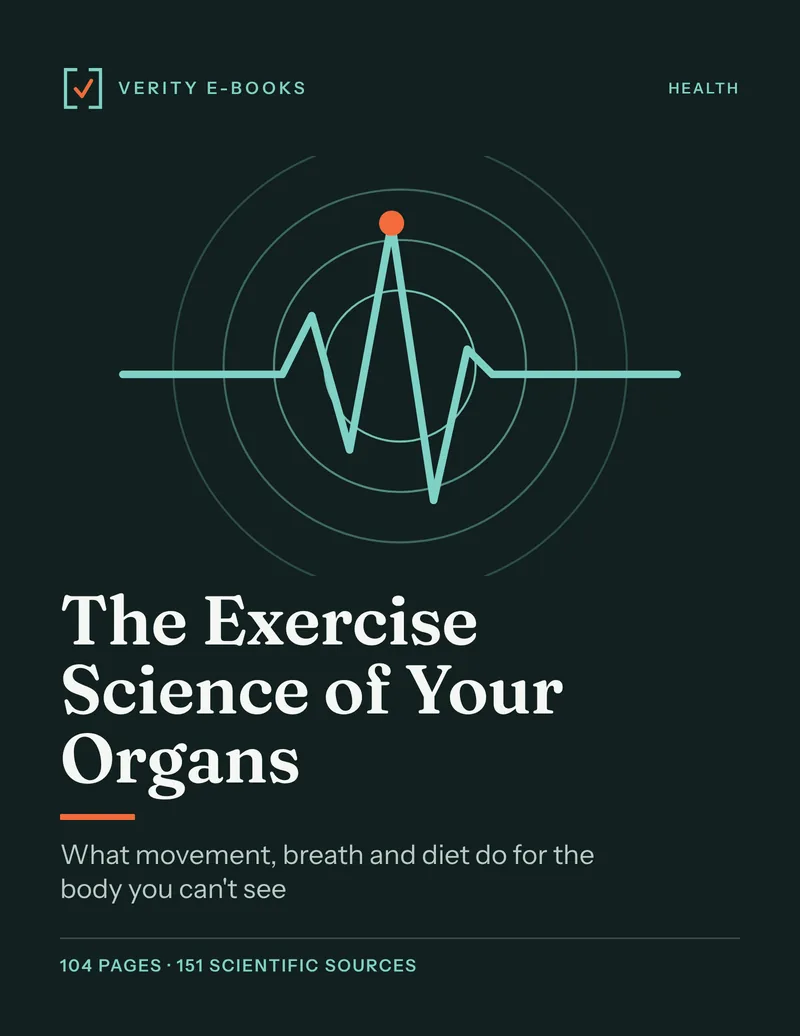
The Exercise Science of Your Organs
What movement, breath, and diet do for the body you can’t see
A chapter-by-chapter tour of the evidence linking movement, breathing and diet to your liver, gut, lungs, kidneys, pancreas, immune system, thyroid, skin, hair and eyes.
$49USD · one-time
PDF · 104 pages · 151 scientific sources
- 7-day refund if the file is unreadable or not as described
- Personalised PDF for your own use, delivered digitally
- Full source list included, every entry tagged by type
- Format
- PDF, US Letter
- Length
- 104 pages
- Sources
- 151 verified
- Publisher
- Verity E-books
About this guide
Exercise is usually sold for what shows in the mirror. This book follows the same inputs (movement, breath, food, sleep, stress) to the organs that never get a rest day. Each chapter names specific, studied interventions and reports the measured effect, on whom, and for how long.
Where a finding is preliminary, small-sample or observational, the book says so in the text, in boxed callouts marked “What the Evidence Doesn’t Yet Show”. It is not a book of miracle organ-specific exercises, and it stays clear of the unproven, borderline-mystical claims that dominate much “internal organ exercise” content online.
Who it’s for
- You exercise, or want to, and you’re curious what it does inside the body.
- You want the evidence graded honestly, not oversold.
- You want a plan: the last chapter turns it into a weekly plan with a twelve-week progression roadmap.
What it isn’t
It is not medical advice and not a treatment plan for any diagnosed condition.
Inside
What’s in the guide
- IntroBeyond Muscle
- 1The Liver
- 2The Gut & Digestive System
- 3The Lungs
- 4The Kidneys
- 5The Pancreas
- 6Your Immune System & Lymphatic Health
- 7Your Stress-Response System & Thyroid Function
- 8Skin, Hair & Eyes
- 9Putting It Together: A Weekly PlanIncludes a twelve-week progression roadmap
- RefGlossary and 151 scientific sourcesClickable table of contents throughout
The evidence base
151 scientific sources, each tagged by type
The full source list is at the back of the guide. Each entry is tagged so you can see what a claim rests on.
- Peer-reviewed research132
- Government, regulatory & medical-authority bodies19
Educational content, not medical advice. If you have a diagnosed condition affecting any organ discussed in the book, it is not a substitute for your physician’s guidance. Talk to a doctor before starting a new exercise program or making a significant dietary change, particularly if you are pregnant, have a chronic condition, or take regular medication.
Questions
About this guide
Is this medical advice?
No. It summarises what peer-reviewed and government-health-agency research has found about lifestyle and organ function in general populations. It is not a treatment plan, and several chapters flag where the research comes from people who are already ill.
Are these “organ exercises” like Qi Gong?
No. There are no mystical claims. It’s exercise physiology: what walking, resistance training, breathing patterns and diet have been measured to do, with the study behind each claim.
How much weight loss does the liver notice?
In a prospective study of patients with NASH (a more advanced form of fatty liver disease), losing 5% of body weight improved fat accumulation in most patients studied, losing 7% or more resolved the active liver inflammation in most patients, and losing 10% or more was associated with scar-tissue (fibrosis) regression in nearly half of patients. The book calls this one of the more specific and well-evidenced findings in liver research. It is a finding in people with NASH, not a promise for everyone.
In the book: Chapter 1, "The Liver" (section "A Concrete, Motivating Number")
What does exercise do for the gut, lungs, kidneys and pancreas?
Gut: regular moderate exercise is linked to greater microbial diversity, and active people have about 24% lower colon cancer rates (an association, not proof of prevention); a ten-minute walk after eating blunts the blood sugar spike.
Lungs: supervised exercise (pulmonary rehabilitation) is among the best-evidenced interventions in the book for people with lung disease such as COPD, improving how far they can exercise and their quality of life without changing the diseased lung tissue itself.
Kidneys: for healthy readers the protection runs mainly through exercise's effects on blood pressure and blood sugar, and structured exercise reduces protein leakage in people who already have kidney disease.
Pancreas: 150 minutes a week of brisk walking plus a modest goal of losing 7% of body weight reduced progression to type 2 diabetes by 58% over three years, and resistance training at 60–80% of one-rep max, two to three sessions a week for at least twelve weeks, improved beta-cell function in people already living with type 2 diabetes.
In the book: Chapter 2, "The Gut & Digestive System"; Chapter 3, "The Lungs"; Chapter 4, "The Kidneys"; Chapter 5, "The Pancreas"
How can I support my immune system and stress response with movement?
Immune: regular moderate activity is associated with lower rates of upper respiratory infection and with better antibody response to flu vaccination, but very prolonged or very high-intensity exercise without recovery can temporarily lower defences for roughly three to seventy-two hours, and in one controlled study sleeping fewer than six hours a night more than quadrupled cold risk.
Stress response: a single workout reliably raises cortisol only above roughly 60% of maximum effort or after ninety or more minutes at lower intensity, and the largest cortisol-lowering effect for regular training was at a moderate volume of roughly 90–150 minutes a week, with yoga and qigong ranking well. The book states that "adrenal fatigue" has no accepted diagnostic criteria, and that exercise is not a way to self-diagnose or self-treat a suspected thyroid problem; a blood test is.
In the book: Chapter 6, "Your Immune System & Lymphatic Health"; Chapter 7, "Your Stress-Response System & Thyroid Function"
What does the research say about skin, hair and eyes?
Skin: a 16-week randomized trial in middle-aged women found resistance training increased dermal thickness, and exercise roughly doubles skin blood flow during activity; the proposed muscle-to-skin signalling is supported in cell and animal research and is not proof that exercise reverses visible skin ageing in humans.
Hair: a four-minute daily scalp massage increased hair thickness at 24 weeks in a small trial, and a survey linking exercise to less severe pattern hair loss is correlational only; correcting a confirmed nutrient deficiency helps, while supplementing without one (biotin in particular) lacks proven benefit.
Eyes: the book supports better blinking habits and general aerobic exercise for blood flow to the eye, and explicitly not vision correction; the 20-20-20 rule is presented as a reasonable break habit, not a validated formula.
In the book: Chapter 8, "Skin, Hair & Eyes"