12-week beginner strength program
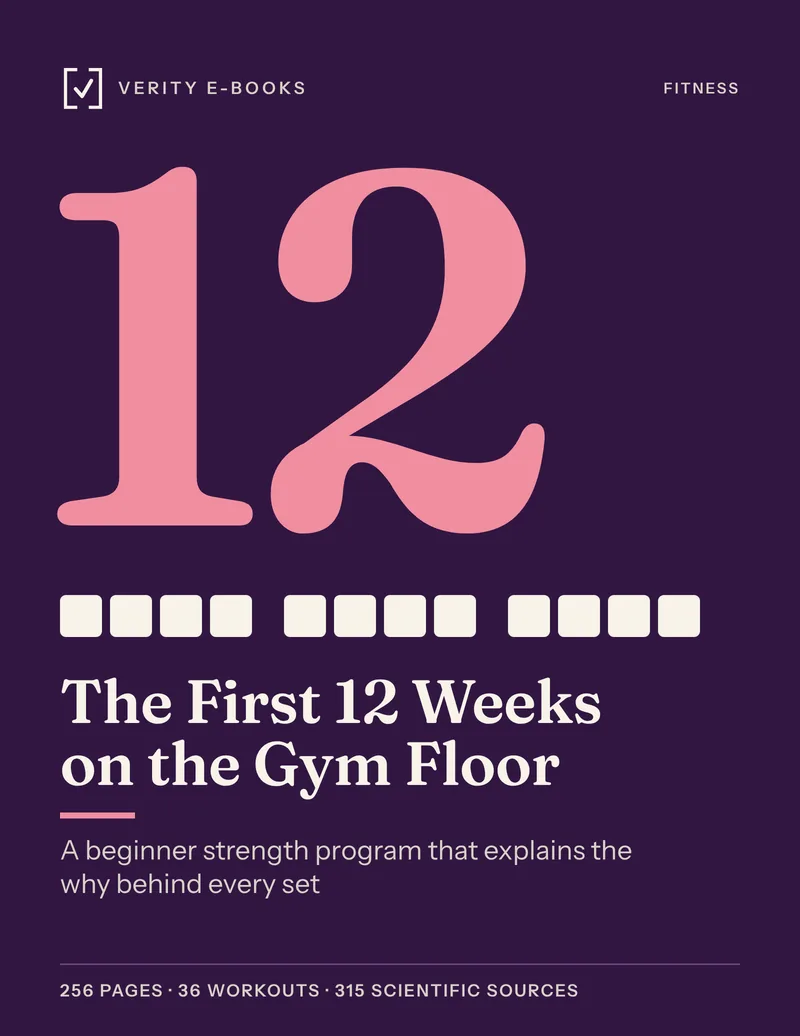
The First 12 Weeks on the Gym Floor
Walk into the gym knowing exactly what to do.
36 guided workouts, step-by-step exercise guides and a learn card every week, with the scientific sources behind it.
Week by week
3 × $12$36 in total
- Week 1 opens as soon as your first payment goes through
- A new week opens every 7 days, so you take it at a steady pace
- Payments: today, after 28 days and after 56 days, taken by Whop
- Cancel any time: email us or sign in to Whop
The complete book
$36one-time
- All 12 weeks in one 256-page PDF, yours straight away
- The same program, with the overview pages and every source in one place
- One payment, no payment plan
- Read at your own pace, in your own order
General education, not medical or diet advice. Check with a doctor first if you have a health condition, are pregnant or are recovering from an injury.
- 7-day refund if a file is unreadable or not as described
- Personalised PDF for your own use, delivered digitally
- 315 scientific sources, each tagged by type
- Program
- 12 weeks · 36 workouts
- Format
- PDF, US Letter
- Complete book
- 256 pages
- Sources
- 315 scientific
The problem
“I don’t know what to do when I walk in.”
You have a gym membership, or you are about to get one. Then comes the floor: racks, machines you cannot name, people who seem to know exactly what they are doing, and workouts written in shorthand like 3 × 10 at 7 out of 10. This program takes the guesswork out of the first twelve weeks: what to do tomorrow, why it is set up that way, and what the research does and does not say.
It is built for people in their first months at the gym, or about to start, who want a plan with clear next steps.
What you do each week
The same four parts, every week
Three sessions a week, always at least a day apart. Sessions A and B alternate, and each week builds a little on the last.
- A one-page overview. Your sessions, the sets and reps, about how long they take, and the muscle groups they train.
- A learn card. One idea each week, with what the research supports and what it does not say.
- A swap list. One small eating-routine change a week, with swaps for dairy, egg, nut, fish and plant-based eaters. No calories, grams or targets.
- A printable log sheet. Weights, reps, reps left, soreness and energy, so you can see your own progress.
Progress checks at the end of Weeks 4, 8 and 12.
Sessions take about 30 to 50 minutes depending on the week (the book’s own estimate). You need dumbbells, a bench and gym machines, including a lat pulldown and a cable row.
Three blocks
Twelve weeks, in three blocks of four
Weeks 1 to 4
Block 1 · Learn the moves
Ten simple exercises, 2 to 3 sets, mostly bodyweight and light dumbbells. Technique first.
 Week 1Leave reps in the bank
 Week 2Add a little at a time
 Week 3Rest days are part of the plan
 Week 4Sleep is a training tool
Weeks 5 to 8
Block 2 · Build the base
New exercises, including machines and a cable row. Every session trains every muscle group.
 Week 5Warm up smart
 Week 6Your cycle and your training
 Week 7Range of motion, and smart swaps
 Week 8Habits, mood and your eating routine
Weeks 9 to 12
Block 3 · Own the gym
Heavier key lifts, a farmer’s carry, easy cardio and an optional finisher.
 Week 9Cardio alongside lifting
 Week 10Steps, sitting and the talk test
 Week 11Soreness, aches, and when to stop
 Week 12What you have built, and what comes next
What is included
Everything in the program
- 36 workouts. Three sessions a week for 12 weeks, A and B alternating.
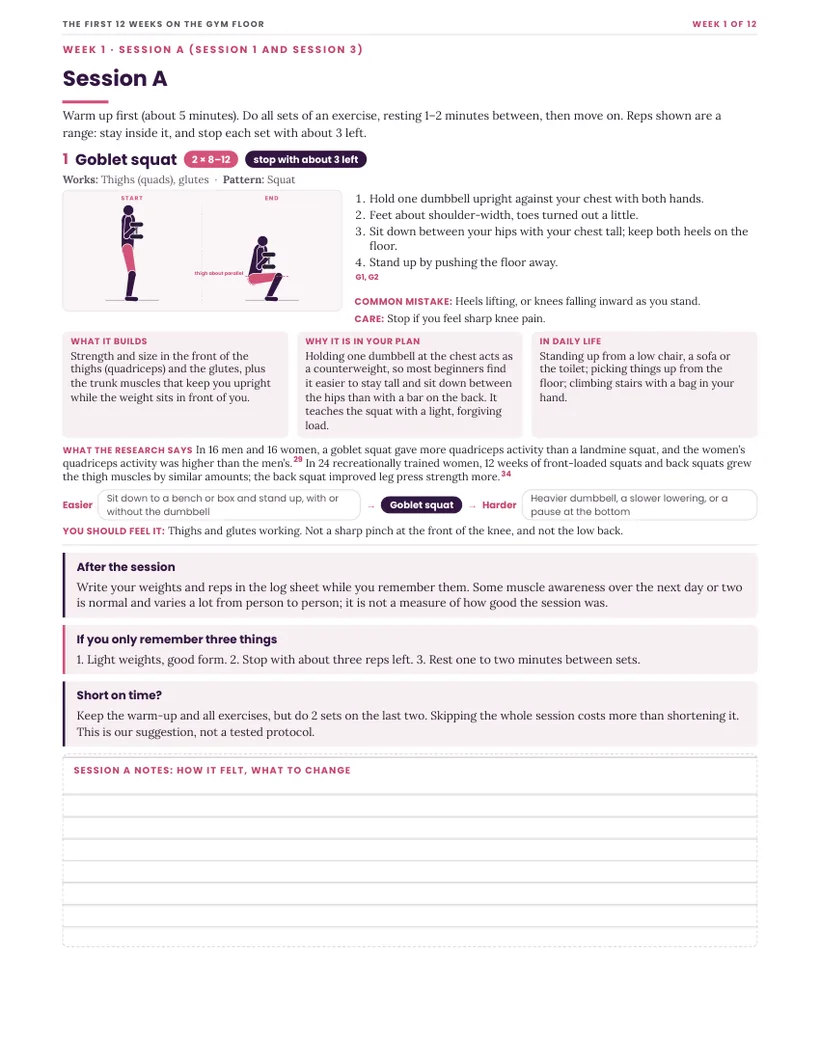
- 22 exercises with figures. Each page shows the start and the end of the movement, numbered cues, a common mistake, an easier option and a harder option.
- 59 exercise technique guides cited for the cues, listed at the back.
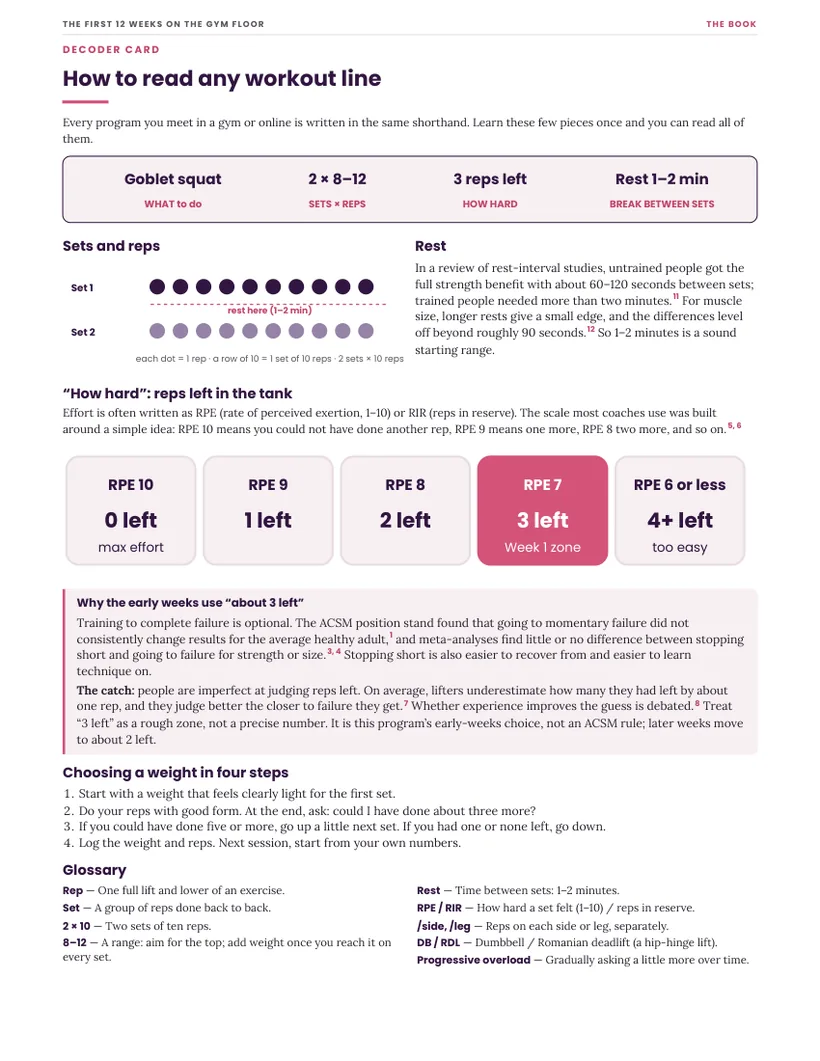
- A decoder card. How to read any workout line: sets, reps, rest, and how many reps to leave in the tank.
- A first-timer’s guide. What to bring, how to check a machine before your first set, how to ask staff, and gym etiquette.
- Safety guidance. A “read this first” box, a link to a free self-screening tool (the PAR-Q+), stop-signs, and a Week 11 chapter on soreness, aches and when to stop.
- 315 scientific sources, each with a short note on what it found and who was studied.
- What comes after Week 12. The last week covers how to raise the difficulty and what to do next.
See inside
Two real pages from the book
The decoder card teaches you to read any workout line. An exercise page shows you the movement. The free sample pages include both, plus the first-timer’s guide and a full Week 1 learn card.
The research behind it
315 scientific sources, each tagged by type
Every week has a learn card that says what the studies found, in whom, and how strong that kind of evidence is. Most exercise-specific studies are small and measure muscle activity, and the book says so on the page. Program choices, such as stopping a set with about 3 reps left, are labelled as our own design rather than as rules from the research.
- Peer-reviewed research292
- Government, regulatory & medical-authority bodies12
- Licensed professional & certification bodies11
Three entries carry two tags and are counted under the first. The 59 exercise technique guides are listed separately.
Who it is for
- People in their first months at the gym, or about to start.
- Anyone who feels lost on the floor or cannot read a workout (sets, reps, rest).
- Anyone who wants a plan with clear next steps, and the reasons behind it.
Who it is not for
- Experienced lifters.
- Anyone with an injury or medical condition who has not cleared exercise with a professional.
- Anyone wanting a diet plan or calorie targets. The book gives none.
Choose how to start
$36, paid your way
Week by week
3 × $12$36 in total
- $12 today, $12 after 28 days, $12 after 56 days
- One new week every 7 days
- Cancel any time, and keep the weeks you have paid for
The complete book
$36one-time
- All 12 weeks in one 256-page PDF
- One payment, yours straight away
General education, not medical or diet advice. This program is not a medical, nutrition or diet plan and does not promise any particular result. If you have a chronic condition, are pregnant, are recovering from an injury, or are unsure whether exercise is safe for you, talk to your doctor before you begin.
Questions
About the program
How does it work?
Three sessions a week for 12 weeks, with at least a day between them. Sessions A and B alternate. Each week has an overview of your sessions, a learn card that explains one idea, a swap list with one small eating-routine change, and a log sheet.
What do I get with the three payments?
Week 1 opens as soon as your first payment goes through, and each next week opens 7 days after the one before, counted from your first payment. Weeks 1 to 4 come with payment 1, weeks 5 to 8 with payment 2 (28 days after the first), and weeks 9 to 12 with payment 3 (56 days after the first). You get a personal page that lists the 12 weeks, with a download button for each week that is open. Your name, order number and date are printed at the foot of every inside page.
Can I cancel?
Yes, any time. Email us from the address you paid with, or sign in to Whop with that email and cancel there (Profile > Orders > Cancel membership). Cancel at least 2 days before a payment date and you will not be charged for that block. You keep the weeks you have already paid for.
Do I need a Whop account?
No. You enter your email and card on Whop’s secure checkout page and that is all. Your program page is reached through your personal link.
What if I miss a week?
Each week opens on its date and stays on your program page, so if you fall behind you can pick up where you left off. Download each PDF as it opens to keep your own copy.
What is the difference between the weekly program and the complete book?
Same program, same $36 in total. The complete book is one 256-page PDF that you pay for once and read in your own order. It also has the overview pages: the 12-week map, the exercise effects table and a short evidence overview. The weekly program spreads the $36 over three payments and opens one week at a time, as 12 separate booklets (Week 1 includes the first-timer’s guide and the decoder card).
Do I need a gym?
The program uses gym equipment: dumbbells, a bench, and machines including a lat pulldown and a cable row.
How long are the sessions?
About 30 to 50 minutes depending on the week. That is the book’s own estimate: a warm-up of about 5 minutes plus the sets and rests.
Is this a diet plan?
No. Each week has one small eating-routine change with swaps for different eating patterns. There are no calories, grams or body targets anywhere in it.
Is this medical advice?
No. It is general education, not medical or diet advice. Talk to a doctor first if you have a health condition, are pregnant or are recovering from an injury. Stop an exercise if you feel sharp pain, dizziness, chest discomfort or unusual shortness of breath.
What if the file won’t open?
Contact us within 7 days of the payment for that block. If the file is unreadable or isn’t what the page described, we’ll send a working copy or refund that block’s payment. Details are in the refund policy.
How do I pick a weight, and how do I know a rep is done properly?
The book's four steps: start with a weight that feels clearly light for the first set; do your reps with good form and ask whether you could have done about three more; if you could have done five or more, go up a little next set, and if you had one or none left, go down; then log the weight and reps and start from your own numbers next session. Stop a set when your form slips, not when the number is reached; in Week 1 the book says that if you cannot pause for a second at the bottom of a squat or press, the weight is too heavy. Each exercise page also shows the start and end positions, step-by-step cues and a common mistake to watch for.
In the book: "Decoder card: how to read a workout line" (Choosing a weight in four steps); Week 1, "Leave reps in the bank"; the exercise pages in Weeks 1–12
What if I am sore, or miss a week?
Soreness: the book says feeling sore the next day is common with new exercises and usually eases as you repeat them, and it is a poor scoreboard; if soreness lasts beyond about three days or limits normal movement, lower the weight next time, and use the 0–5 soreness rating in your log. Stop signs that are not normal soreness are chest pain, severe dizziness, sharp or joint pain, numbness, or very dark urine.
Missing a week: missing a few days is not a problem and a longer break costs a little; strength fell after stopping resistance training, and fell further with longer breaks, but people kept some advantage over an untrained baseline, so restart a little below where you stopped and let your log guide the first session.
In the book: Week 11, "Soreness, aches, and when to stop"; Week 3, "Rest days are part of the plan" (Questions people ask)